
Quantum Minds
/On this World Quantum Day, we explore the fascinating parallels between quantum systems and the human mind, uncovering how the strange logic of quantum computing might inspire new ways to understand mental health. In Quantum Minds, we delve into how uncertainty, complexity, and entanglement aren’t just principles of physics—they may also shape the way we think, feel, and heal.
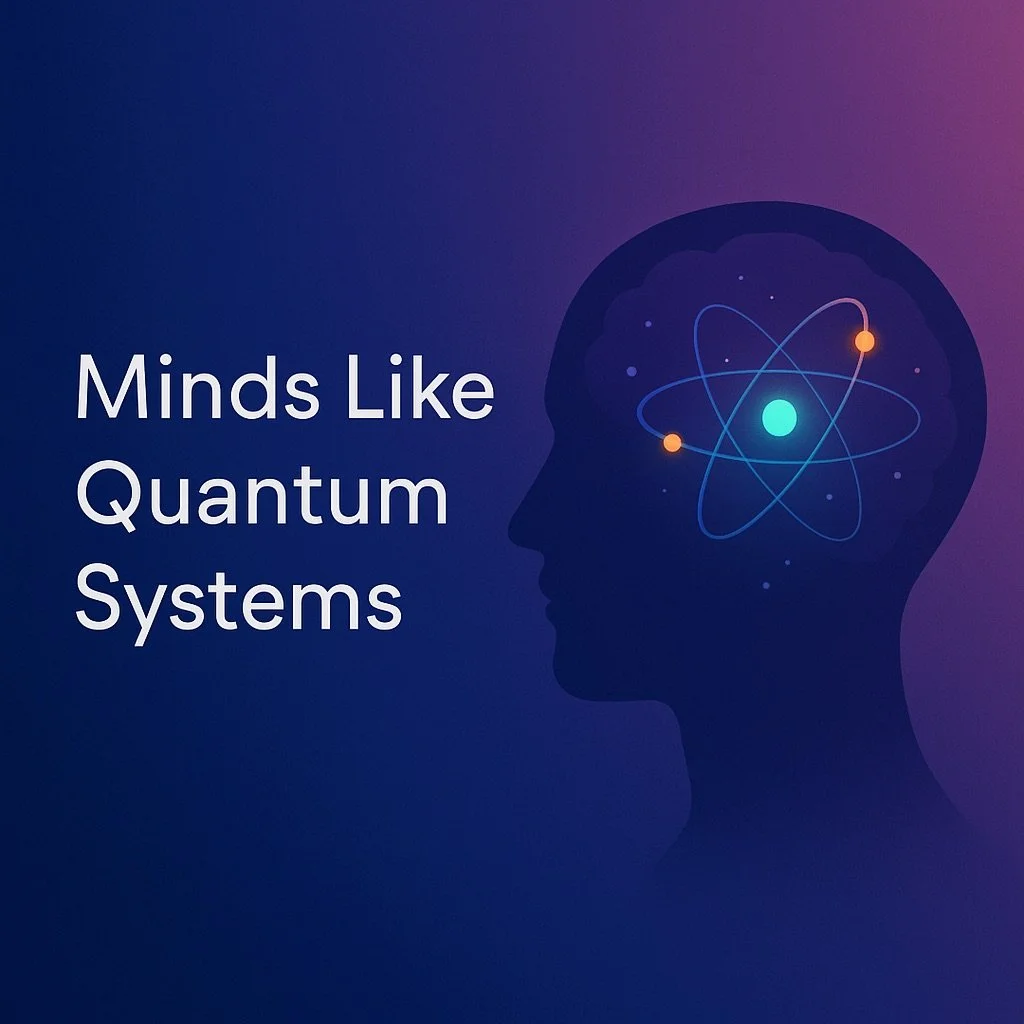
Minds Like Quantum Systems: What Mental Health Can Learn from Quantum Computing
By Dr. Arghya Sarkhel, Consultant Psychiatrist at Living Mind
We live in a world where complexity is the new normal. As a psychiatrist, I’ve spent years understanding the intricate workings of the human mind. But recently, my curiosity led me into an unlikely field: quantum computing. And to my surprise, I found fascinating parallels between the two. Both the human mind and quantum systems defy traditional rules — they are unpredictable, multidimensional, and deeply interconnected.
Let’s explore how concepts from quantum computing can offer us a fresh perspective on mental health and therapy — with examples that anyone can relate to.
1. Superposition: Holding Two Truths at Once
In quantum computing, superposition refers to the ability of a quantum bit (or qubit) to exist in multiple states at the same time. Unlike classical bits that are either 0 or 1, a qubit can be both — until it’s measured. Now think about your emotions. Have you ever felt happy and sad at the same time? Anxious but excited? We often try to label our feelings as either/or — “I should be grateful, so why do I feel low?” But mental states are more like qubits — we can experience multiple emotions simultaneously, and that’s perfectly normal.
Therapy Tip: Instead of trying to “resolve” your emotion into one clear state, allow yourself to sit with the mix. Naming the different layers of your feeling can itself be healing.
2. Entanglement: We Are Deeply Connected
Entanglement is a phenomenon where two particles become linked, so the state of one instantly affects the state of the other — no matter the distance between them. Sound familiar? This mirrors the way human relationships affect our mental health. A loved one’s mood can lift or drain us instantly. Traumatic experiences in childhood can shape adult responses, long after we’ve “moved on.” The mind, like entangled particles, doesn’t forget its connections.
Therapy Tip: Healing isn’t always about changing yourself in isolation. It often involves revisiting and reworking your emotional ties with people, past and present.
3. Uncertainty Principle: The More You Try to Pin It Down, the Blurrier It Gets
In quantum mechanics, the Heisenberg Uncertainty Principle tells us that we can’t measure both the position and momentum of a particle precisely. The more we know about one, the less we know about the other. Likewise, in mental health, the harder we try to control or explain away certain thoughts — like anxiety or intrusive images — the more elusive they become. Obsessive focus can amplify discomfort. The answer often lies in stepping back, not zooming in.
Therapy Tip: Sometimes, instead of overanalysing our thoughts, we need to observe them gently, like clouds passing in the sky. Acceptance and Commitment Therapy (ACT) is built on this idea.
4. Collapse of the Wavefunction: The Power of Attention
In quantum theory, when we observe a qubit, its multiple potential states “collapse” into one outcome. Observation changes reality. Our minds are not so different. What we focus on grows stronger. If we constantly focus on what’s going wrong, we reinforce our brain’s stress response. But if we learn to pay attention to what’s working — even small wins — we rewire our mental pathways over time.
Therapy Tip: Mindfulness, gratitude journaling, and positive psychology aren’t just trendy — they’re ways of intentionally directing our “mental observation” to strengthen healthier patterns.
Final Thoughts: The Mind is Not a Machine — It’s a Universe
Quantum computing shows us that not everything has to be linear, binary, or explainable. The same goes for our mental health. We aren’t broken machines to be fixed; we’re complex systems to be understood and supported. At Living Mind, we believe in approaching mental health with curiosity, compassion, and creativity. Whether it’s through traditional therapy, mindfulness, or just changing the way we relate to our thoughts — healing happens when we honour the mind’s complexity, rather than trying to simplify it too soon.
About the Author
Dr. Arghya Sarkhel is a Consultant Psychiatrist and the founder of Living Mind, a private healthcare clinic with locations in London and Essex. Living Mind offers a unique integrated approach to mental health care. Living Mind combines traditional medical practices with innovative therapies, including rTMS, to support individual well-being.